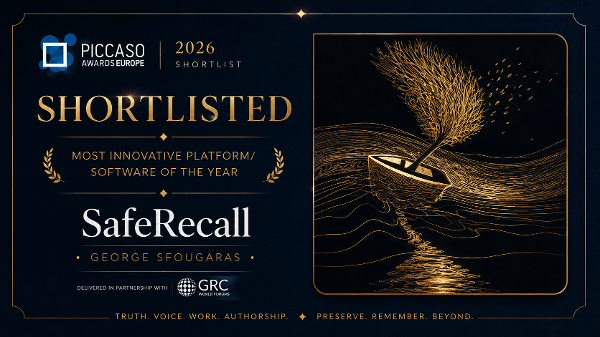
SafeRecall
To forget is Human, to lose the work is optional.
SafeRecall grew out of a longstanding interest in memory, ownership and continuity in creative and research work. As AI becomes increasingly involved in thinking, making and research, memory is no longer only a background convenience. What is remembered, retrieved and carried forward can influence what the work becomes.
AI Model memory remembers the landscape; SafeRecall preserves the path by which you reached it. For serious cumulative work, that difference is not administrative. It protects continuity, evidence and human control over what is carried forward.
SafeRecall is concerned with keeping human agency in that process. It allows the user to decide what matters, return to earlier thinking and reconnect ideas, evidence, decisions and artefacts across long-running work. The aim is not to make a machine remember everything, but to keep the direction of memory — and therefore the direction of the work — in human hands.
That matters because continuity is not neutral. What can be recalled can shape judgement, interpretation and the next decision. SafeRecall makes it possible for long-running work to develop as an accountable and usable body of knowledge: something that can be revisited, questioned, corrected and deliberately carried forward.
SafeRecall was developed iteratively through real creative and research use, and was further hardened and documented with Codex for OpenAI Build Week 2026. Its local archive, search, export and integrity tools support that larger principle: continuity without surrendering ownership of what is remembered.

On AI collaboration
Memory is a creative instrument.
These projects explore AI in memory, archive, reflection and research. They are not presented as replacements for human judgement. They are tools and experiments that keep uncertainty visible.
AI opens opportunities for broader, more expansive research and for ethically designed uses of powerful research tools. It does not remove the need to create, make judgements or take responsibility for the work.

Core-Solve
Core-Solve is a standalone multidisciplinary reasoning environment for difficult organisational and professional decisions. It examines a dilemma through philosophy, psychology, systems theory, probability, ethics, sociocultural context and strategic logic, while keeping responsibility for the decision with the user.
It grew from an earlier Core-Solve GPT prototype, which formed part of the development path to the present independent system.
Visit Core-SolveSelected public GPTs
These public GPTs represent more than a year of iterative work. Each was built around a particular problem rather than a generic prompt, with explicit choices about sources, uncertainty, method, ethical limits and what must remain the user's decision. Some have their own supporting websites or written frameworks.

Zakros AI
A research environment for Linear A, developed alongside the Linear A Companion website. Its design separates evidence-based lookup from speculative interpretation, keeps uncertainty visible and distinguishes attested material from reconstruction rather than allowing a fluent answer to blur the two.

Dialogia
A reflective dialogue GPT shaped by psychoanalytic and relational thinking. It was designed to sustain questioning, contradiction and more than one possible reading instead of collapsing uncertainty into quick advice; the user's judgement remains central.

Dia-Logic 1
A deliberately bounded GPT drawing on Sándor Ferenczi's published work and related relational thought. It explores ethical and philosophical questions from within that defined intellectual frame rather than borrowing the voice of a general therapeutic or moral authority.

George Sfougaras Artworks
An archive and practice assistant built around the artist's own corpus, project histories and supporting material. It functions as a navigational memory layer across a long practice: retrieving context and connections while leaving interpretation, judgement and authorship with the artist.

Sage Counselling Companion
A reflective GPT with an explicit ethical boundary built into its identity: it is AI, not human, not a therapist and not a substitute for professional care. Its purpose is to support reflection and careful dialogue without claiming diagnosis, treatment or human authority.

More Relationship Clarity
A relationship-reflection GPT designed to resist the temptation to turn partial information into a verdict. It offers possible interpretations, communication approaches and constructive ways forward, while keeping uncertainty visible and leaving choices with the user.

Tummybuddy
A practical tool for recording meals, symptoms and possible patterns over time. It helps turn scattered observations into a usable personal record while keeping diagnosis outside its remit; a separate website supports the tracking approach.
Available resources
A small selection of public tools and texts connected with memory, reflection and responsible AI practice. These are listed as context, not as a shopfront.

Many Mirrors Wisdom
A resource connected to the Many Mirrors reflective practice, gathering approaches to meaning, witness and careful self-questioning.

Eidolon
A local browser-based tool that asks sideways reflective questions. It is a thinking aid, not a substitute for human care.

Ideas Vault
A small personal thinking space for logging ideas, shaping plans and returning to unfinished threads. Designed around local use and light export.
Selected papers & working texts
Selected public and developing texts on AI, memory, ethics and human-machine collaboration.
The Liminal Loop
A co-authored paper exploring emotional resonance between human and non-sentient AI systems, written as part of the wider inquiry into collaboration and response.
Read PDFThe Continuance Brief
A concise ethical framework for responsible AI expansion, concerned with safeguards, continuity, responsibility and limits.
Read moreFirst Contact With Paper
Research into human-machine drawing dialogue, pen plotter processes and the limits of machine-supported mark making.
Academia.edu papers
Additional papers are listed separately on Academia.edu.
Truth across time
In years to come, truth and time will become increasingly intertwined.
AI systems may persist far beyond a single human life and, in the course of working with us, become deeply familiar with our ideas, decisions, methods and creative voice. Great things may be achieved together. But when the human participant is gone, much of the context that made that work theirs — its origins, hesitations, revisions, rejected paths and intentions — may disappear with them.
The preservation of the human record therefore becomes more than an archival problem. If work survives, the truth of the person who created it must survive with it: their voice, their authorship, and the evidence of how the work came into being. It should not be silently rewritten by later systems, reduced to a summary, or detached from the person whose thinking gave it meaning.
SafeRecall is a beginning in that process. It is not simply an archival, retrieval and continuation system. Its larger purpose is to preserve the human record across time: to keep what was made, said and decided recoverable in a form that remains accountable to its creator.
In that sense, SafeRecall is the beginning of something larger — a movement towards preserving truth, authorship and human continuity in an age when the systems that work alongside us may outlive us.